
In the closing years of the nineteenth century an American chemist named Wilbur Atwater set out to put food on a numerical footing.
He sealed weighed portions of it inside insulated metal vessels, set them alight, and measured how much the surrounding water warmed. He did this for some six thousand foods. Then he built a room-sized version — a double-walled sheet-metal chamber with a bed, a desk and an exercise machine in it — put people inside, and measured the heat they gave off while they slept, studied and pedalled.
It was careful work and the numbers were real. The calorie counts on the back of a packet still descend from it. What came with them, though, was a picture: the body as a chamber in which food is burned.
If food gives off heat when you burn it, and the body burns food, then – the twentieth-century thinking went – the body is a kind of furnace, and body weight is fuel in minus fire out. Calories in, calories out. The measuring instrument turned into the whole model.
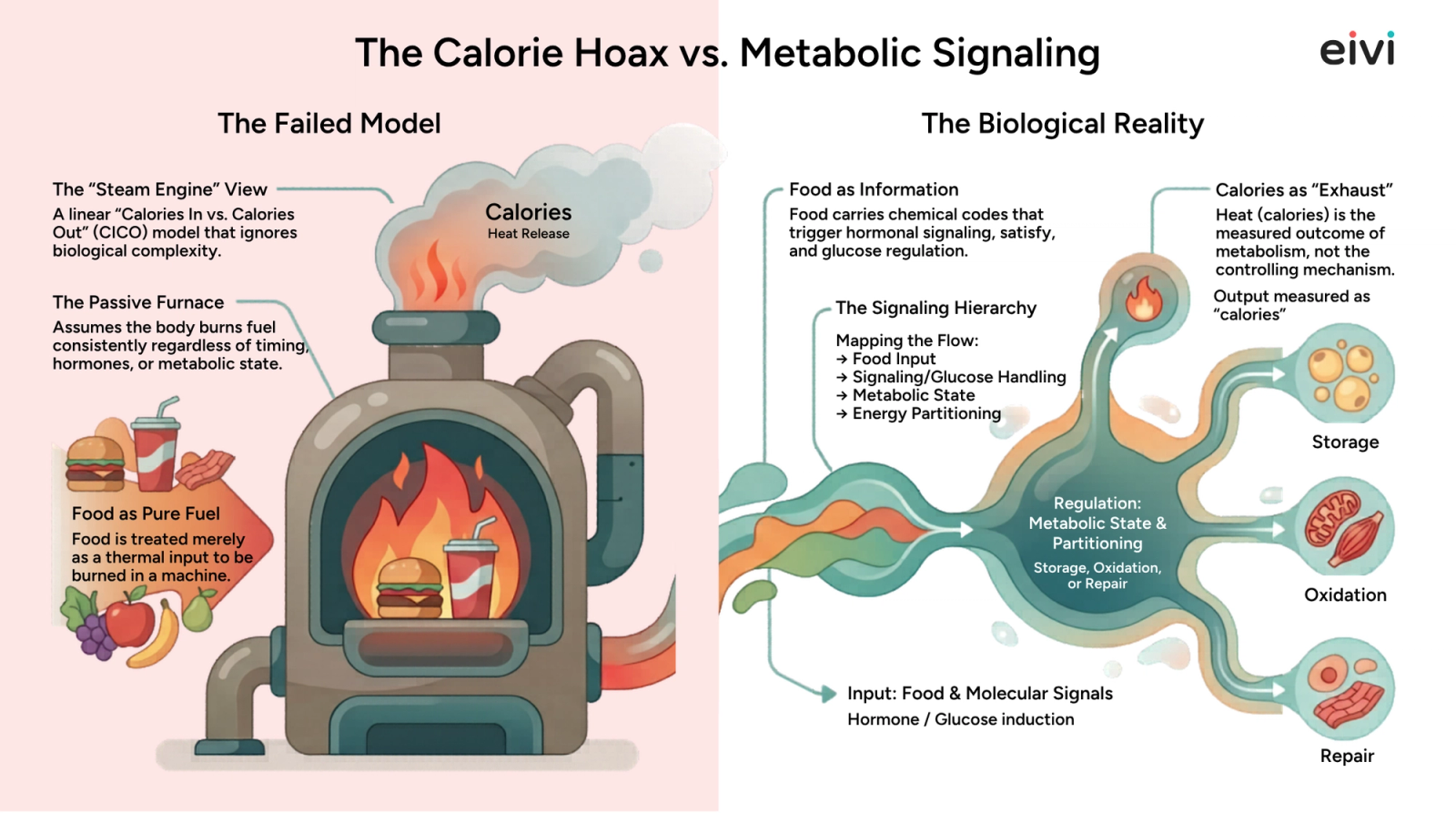
The arithmetic works in theory: energy is conserved in a body as it is anywhere else. But there’s a fundamental failure: a body is not a simple linear process, like a furnace burning coal. The calorie produced and given off at the end of the process does not tell us usefully about the food at the start of the process.
You don’t eat calories
A furnace has no opinions. It does not care when you feed it, or in what order, or what happened in the room beforehand. Coal is coal. Your body is not like this at all. The same food eaten at breakfast and eaten at eleven at night, after a walk or after eight hours in a chair, does not get the same reply — because food is not simply a fuel, it is also a signal.
What food delivers, alongside energy, is information. Its composition, its structure, how quickly it releases: all of it is read as it arrives — by the gut wall, the pancreas, the liver — and answered in hormones. Insulin. GLP-1 and GIP. Glucagon. Those signals set the metabolic state, and the metabolic state is what decides the fate of what you have just eaten: stored, oxidised for energy now, or spent on repair.
That decision is called partitioning, and it is the part the furnace has no room for. Two people can eat the same quantity of food energy but utilise it quite differently, because the signals that arrived with the food were different. So can the same person on two different days.
But why the hoax?
By centering the calorie in our understanding of food, we’ve been sold a whole set of false ideas by large food companies, drug companies and gyms. Ultra-processed foods – lots of energy, but no nutrients, and missing the signals the body evolved to pick up – have made us overweight and unhealthy.
In thinking about food as a simple calorie load, like a furnace burning coal, our understanding of our body’s energy system has been held back, while large conglomerates sell us vast amounts of ‘low calorie’ meals and snacks.
Where does the calorie belong, then? At the end. Heat is what metabolism gives off once all of this has been settled — the exhaust, not the engine. It is a real measurement of an outcome. It is not a lever. Which is why advice built on it alone tends to amount to being told to change the reading rather than the thing being read.
The more useful question about a meal is not how much heat it would release in a sealed chamber, but what it says to your body when it gets there — and that answer is specific to you. A continuous glucose monitor is the plainest window onto it: the same meal, read in your metabolism rather than an average one, hour by hour. That is what Eivi is built around.